Friday, May 27, 2011

Thai Ghost House – Part I
After Pom helped me obtain an amulet that was supposed to attract ghosts (see previous blog), all I needed was the right opportunity. To my surprise, I found it on the campus of Silpakorn University where Mary and I were living while in Thailand.
The old, abandoned traditional Thai house on campus is called Reun Prakumsakkee. I discovered that, in 2010, an Italian visiting artist named Alessandra Campoli gave a mixed media performance titled Haunted in the house. By email Alessandra told me that it was necessary to perform a two-day ceremony at the house in order to get permission of the resident spirits to hold the performance there.

I also heard stories about people seeing a ghostly woman wearing old-style Thai clothing at the house as well as the ghost of a little girl who reportedly fell off a swing and died.
Kanyarat Vechasat, a professor of Thai literature and folklore, serves on a committee that protects and preserves such old buildings on the campus. She told me that, at one point, university officials were thinking about relocating the old house. She went to the house and prayed that, if there was a spirit residing there, it should send her a sign. After praying, Kanyarat saw two pythons at the house, entwined and standing upright (almost five feet high!). She took their presence as a sign from the spirit of the house. She told university officials about the snakes and they said that other people had reported the same phenomenon. The officials decided that a spirit did, indeed, live in the house and it was not moved.
I walked to Reun Prakumsakkee and stood there for awhile looking at it. The house stood in a lot with grass deep enough to hide cobras, pythons, or the ubiquitous water monitors that crept up from the water. The wooden house was weather-beaten and faded, the shutters over the windows ajar, the windows like empty eye sockets. Raised on pilings several feet above the ground, a splintered wooden pallet leaned against what was left of the stairs, obviously placed there to prevent anyone from entering the house.
So, of course, I climbed up the rickety pallet and up the rotting steps, fully believing that I would fall through at any time. I didn’t. Reaching the porch, I opened the door and went inside. Gray light filtered in through the open windows and profound silence settled over the rooms like a shroud.

As I walked through the rooms noticed offerings made to the spirits during the 2010 ceremony, including a statue of a Hindu deity riding on a garuda.

Photographs of the Thai king and queen and of a mysterious young girl hung on the walls.

Some empty liquor bottles stood in a rank upon a shelf.

Clearly, the ceremony to appease the spirits had been an elaborate one.
Then it struck me that the spirit still remained in the house.
Stay tuned for Part II
  

Saturday, April 23, 2011

Here are a few more photos from my amulet buying experience in Nahkon Pathom, Thailand (see previous blog).

Mr. Flying Ice Cream Guy, the amulet (and ice cream) vendor and I check out the inventory.


Using Pom's note, Mr. Flying Ice Cream Guy suggests an amulet that will help me see and communicate with ghosts.


"Very good! Number one!" says Mr. Flying Ice Cream Guy, as he recommends the Phra Phid Ta amulet (note his "thumbs up" sign).


The deal is done! I'm the proud owner of a Phra Phis Ta amulet.


Thursday, April 21, 2011


Thailand is full of ghosts and other spirits.
No self-respecting Thai would be caught dead (no pun intended) without some charm or amulet on his person to protect him or to bring him luck. Many men will wear an amulet around their necks, just as Christians will wear crosses or medals of saints. Women may also wear amulets or they might carry a charm or medal in their purses and almost every car in Thailand will carry its own little shrine on the dashboard honoring Buddha or a Hindu deity, or perhaps a favorite monk.

The sale of amulets in Thailand is a big business. Most wats (Buddhist monastic complexes) sell them and they are ubiquitous in all the night markets. Bangkok has an entire section know as the Amulet Market, at which scores of sellers display table after table of amulets, charms, and medallions. I visited the market and was overwhelmed by the sheer number of items offered for sale, literally a million or more.
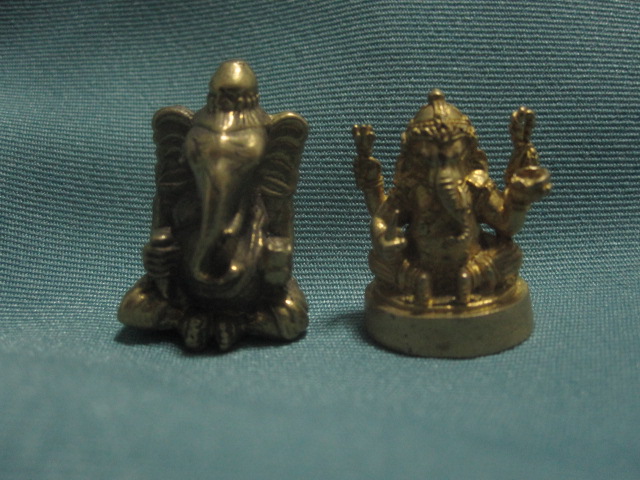
People are serious about their amulets. It is not uncommon, as I noticed at the Amulet Market, for a savvy buyer to use a jeweler’s loupe to closely examine the item for age and authenticity. Some amulets are antiques and prized by collectors, others are designed to be worn. They come in all shapes and sizes, depicting a wide range of spirits, gods, and holy men. They may be made of metal, ceramic, terra cotta, wood, sometimes even plastic. A monk gave me this Ganesh amulet.

Any good bookstore will carry one or more of the several magazines devoted entirely to amulets. New amulets are often advertised on billboards, often with a larger than life picture of the designer, usually a monk. Some monks have achieved celebrity status through their art and their amulets are highly prized.
Amulets are frequently worn for protection against accidents, sickness, bad luck, and, of course, evil spirits and ghosts. So, when I said I wanted an amulet that would attract ghosts, I certainly got strange looks. But I’m a ghosthunter; wouldn’t such an amulet make sense?
I asked my friend Pom at Silpakorn University in Nahkon Pathom to write me something in Thai that I could show to an amulet seller. Pom wrote, “Would like to have something that can give me access to contact/see/talk to spirits/ghosts—I don’t want to use this as an evil thing or to hurt anybody.” Alright then, I was good to go. I found my amulet dealer at the Nahkon Pathom night market outside the Phra Pathom chedi, the tallest Buddha memorial in the world.
The dealer had two stalls side by side at the market, one to sell amulets, the other to sell “flying ice cream” (nothing like diversifying in business). Mr. Flying Ice Cream guy wowed the crowds by scooping out ice cream then flinging it high into the air and catching it in the scoop behind his back. Another Thai that spoke English said that Mr. Flying Ice Cream claimed he had performed in Hanoi, Beijing, and Las Vegas; I had my doubts, even in Vegas.
Mr. Flying Ice Cream read Pom’s note and knew immediately which amulet I should buy. He showed me one that depicted a monk with his hands covering his face. He kept smiling, pointing at the amulet while giving me a thumbs-up sign and repeating, “Number one!” On a piece of paper he wrote down the price—5,000 Baht, about $150. I wrote down 1,000 Baht, about $30. We settled at 1,500 Baht, about $45, which meant that the amulet was probably worth about $5. The sacrifices I make for research!
The amulet (below) is called Phra Phid Ta, which roughly translates to “monk closed eyes.” It depicts a monk who, according to legend, closely resembled the Buddha and was often mistaken for him. His sense of humility and respect for the Buddha caused him to cover his face with his hands so that no one would ever take him to be the Buddha again.


The amulet is supposed to protect the wearer from harm—especially from knives and guns—and is also supposed to render the wearer nearly invisible to his opponent. I wondered if someone “nearly invisible” would look like a wispy ghost. Perhaps that was how one attracted a ghost, by looking like one. I didn’t know for sure, but I would soon find out.
Stay tuned!

Tuesday, April 5, 2011


In the early morning, as dawn streaks the gilded peaks of the temples with a rosy brush and the streets below are only beginning to wake, come the monks. Silently they come, wrapped in their saffron robes, alms bowls held before them for the elderly women that respectfully drop food into them. The monks walk in single file, barefoot, the eldest first, the youngest—who may be only a boy of ten years or younger—at the rear, each of them keeping enough distance between them so that no one’s shadow falls upon a fellow monk.   
The monks are not begging for their sustenance. Rather, they are giving their fellow Buddhists a chance to earn merit for themselves through their generosity. Such is the role of the monk; to earn merit, yes, but also to help others do so.

Thailand is 95% Buddhist and the influence of the religion is felt everywhere, sometimes subtly, as in a Buddhist amulet worn discretely around the neck beneath a shirt, or more ostentatiously, as in the soaring, gilded wats (monastery complexes) are ubiquitous to the Thai landscape.
For a Westerner It is difficult to understand that almost every Thai male will spend some time as a monk. That may be a lifetime, or it may be as short as a single day, but it is the rare male that does not spend some time barefoot, wrapped in robes, contemplating the teachings of the Buddha.

A man cannot be ordained as a monk until he is at least twenty years old. Until he reaches that age he is considered “unripe,” not yet mature enough to be ready for marriage and responsibility. When a man is ordained into monkhood, he shaves his head, eyebrows, and facial hair and dons the saffron or maroon monastic robes. Boys under twenty years of age may also join a wat as a novice. Like the monks, they too shave their heads and wear robes.
While novices take only ten vows, monks take 227 vows, including abstinence, poverty, obedience, and chastity—a monk cannot touch a woman, even his mother an anything given to a monk by a woman must first be placed on a cloth or some other receptacle before it can be touched by the monk.
Life in the wat is quiet and studious. Most of the time is taken up by religious studies, chanting and meditation, interspersed with some free time for individual study. Monks begin their day with chanting and meditation at 4 a.m., leaving the monastery at 6 a.m. for their rounds of the neighborhood with their alms bowl. Breakfast is at 8 a.m. with the last meal of the day being taken at about noon. After that are more classes, chanting and meditation until bedtime.
Unlike cloistered monks of other faiths, Buddhist monks are very much in evidence in the community. Besides their morning rounds, they are often seen coming and going to and from the wat; browsing in the markets (especially amulet markets and book stalls); riding buses and motorcycle taxis (“motocys”), and, of course, going about their daily routines in the wats, which are open to the public. The monks are so visibly present in the community in order to continually remind people of the Buddha and his teachings and to provide a means by which people can earn merit, especially through alms-giving.

What does it say about a country in which all the men become monks? Certainly the people of Thailand, their friendly natures notwithstanding, are neither more nor less saintly or holy than the rest of us. Yet, is there not something gained, even if only fleetingly, when one turns away from the mundane world to concentrate on the divine, however that divinity may be perceived? Is there not hope that such a fermata may take hold in one or several of us? And if that happens, is there not hope that in that stillness divinity can make itself known to all?

Thursday, March 17, 2011

Thailand is a haunted country.

Despite the fact that 95% of the population is Buddhist, Thai Buddhism comes laced with a healthy dose of animism, a belief in spirits in everything. Centuries before Buddhism found its way into Thailand, the Thai people recognized spirits in the air, the water, the ground, trees and plants, animals--spirits everywhere and in everything.

Today, all buildings in Thailand, whether they be private homes, businesses, public buildings, hotels, hospitals, schools, etc. have spirit houses standing before them, new homes for the spirits of the land that were displaced when the structures were built. No self-respecting Thai would be caught in public without an amulet or charm of some sort to help protect him from malicious spirits or to bring him luck and good fortune. Sacred trees are often girded with seven-color cloth, a sign of respect for the spirits living inside them.

In such a country, then, it comes as no surprise that ghosts are everywhere, even on the campus of Silpakorn University in Nakhon Pathom. "There are souls in the water," a professor of biology told me. "You can see them late at night, just below the water. I see them all the time," she said.

She went on to tell me that she sees "souls," as she called ghosts, in many places. "They are trying to tell me something, or they want me to do something, but I don't know what."

"Do you know about the ghost house?" an engineering professor asked me. I told him I did not and he pointed out the old-style wooden Thai houses on stilts at the far end of the campus. "No one lives in them anymore," he said.

"Why are they haunted?" I asked.

"I don't know," he said, "but people see the ghost of a woman there, wearing traditional Thai clothing."

"Do you believe in ghosts?" I said.

The professor was shy in answering, but his guarded reply indicated that, yes, he thought ghosts were a possibility.

The Thai will tell you that ghosts will steal your soul and they do not like to be out late at night, especially alone. Even on hot nights, some Thai will make sure their windows are closed in order to keep ghosts at bay.

I have yet to walk near the lake late at night or to visit the ghost house, but rest asured I will before I leave the university. Perhaps, I'll have a ghost story of my own to tell.

Monday, February 28, 2011

Each morning the mahouts at the Elephant Conservation Center in Lampang begin their day by paying homage to the shrine of Ganesha, the elephant-headed deity of both Hindus and Buddhists. There are several different stories that explain how Ganesha lost his head, none of them suitable for the squeamish. One might question his father’s choice of an elephant head as replacement, but it is generally not wise to argue with Shiva—you’re better off with the head of a pachyderm.

Ganesha is the Lord of Obstacles. He both removes obstacles from your path, much as an elephant would do, or he places them squarely before you, just like a stubborn elephant. So, it seemed appropriate that I joined the mahouts at the shrine before beginning my mahout training course. As the fragrant incense from the joss sticks swirled into the sky, my prayer to Ganesha was simple enough: “Please, go easy on me.”
A few minutes later I was introduced to my elephant for the day, Pang Jan Pen (Full Moon), a 54-year old female, that was described as both “stubborn” and “afraid of trucks.” Great. Her mahout was a joyful little guy named Peng; he had a startling resemblance to Ernest Borgnine. The first thing I learned was the basic commands in Thai that I was told Pang Jan Pen would understand. . . but not necessarily obey.  I stood close to her, patting her, gazing into her gentle, dark eye, trying to work my charms on her, but I don’t think she was having any of it.
Then it was time to climb aboard. There are several ways to mount an elephant, none of them easy. Peng patiently showed me how to perform each one and not so patiently hoisted my posterior aloft when needed. Once aboard I sat right behind Pang Jan Pen’s head, my knees behind her ears, my hands placed on her massive head. Wow! Sitting so high up there, looking down on miniature Peng, it was easy to feel like royalty. I could feel the awesome power of this animal even as she silently stood there unmoving. She was Ganesha incarnate; every obstacle would crumble before her.

“Pai! Pai!” and some pushing behind her ears got Pang Jan Pen moving forward. Over the next several hours I rode my mount down roads and into the forest, over rugged trails. I would like to think that I was in complete control of my elephant, but I know better. Miss Pen was merely humoring me. And her real mahout, Peng, was never far away (thank Ganesha!).
After awhile, though, it felt as though the elephant and I had agreed to work as a team. I could see the world as she saw it, as though looking through her eyes. I could feel her caution as she maneuvered over slippery rocks in a creek, could feel her happiness in cruising down the open road just like the world’s largest ’57 Chevy. And, of course, she became my legs as we merged into one creature—Ganesha-like.

At one point we entered a lake to give her a bath. While I clung desperately to her ears, Pang Jan Pen submerged completely, the waters of the lake rising up to my chest, while Peng stood on the elephant’s back and scrubbed it.
After her cool bath, I rode her back to the Training School where she would relax for the rest of the day and I would try to repair my leg muscles, stretched like rubber bands to the consistency of wet spaghetti. With the command “Tack long,” Pang Jan Pen rolled her trunk and dropped to her knees,  her head lowered to the ground so that I could slide off it.
“Dee mak, Pen,” I said, very good.
Walking by the shrine to Ganesha, I murmured my thanks that he had, indeed, gone easy on me.


Monday, February 21, 2011

Everyone should have a traditional Thai massage once in their lives, if only to remind themselves never to do it again.


Wipe out all those salacious images of Thai "massage" that you might be harboring in your mind ("rub-rub" as it's known in Bangkok's red-light district); the real McCoy is serious business. Ja was a middle-aged handsome woman with the complexion of polished teak and the triceps of an arm wrestling champion. Her polo shirt and warm-up pants could not disguise the firm, compact body that was about to own me for the next sixty minutes at the price of $200 Baht, roughly seven dollars.


After changing into a pair of baggy pants and t-shirt, Ja had me lie on my back on a mat and before I knew it, I was in trouble. She was friendly and spoke English fairly well, yet still did not understand my grunts and groans as she proceeded to pummel, poke, and punch my legs, often twisting them into pretzel shape. She sat with her back to me and wrapped my leg around her with a choke-hold she learned from Seminole alligator wrestlers.  She kneaded every nerve and pressure point I had, making my leg twitch and jump just like an experiment I conducted in my college biology lab with a muscle dissected from a frog's leg. But that lucky frog was already dead and couldn't feel the pain.


The next thing I knew Ja was sitting between my legs, doing who knew what. Other than my wife no other woman had ever occupied that position. But Ja was still all business and continued to professionally inflict pain upon me in a casual, good humored way. She chatted amiably with me and warned me to be careful in Bangkok where political demonstrations between Red Shirts and Yellow Shirts were once again turning violent. As she worked on my arm, bending it behind my head in the half-nelson style of Hulk Hogan, I wondered if I wasn't better off taking my chances with the protesters.


Ja made me roll over onto my belly and then she proceeded to beat me up some more, working up my legs, my back, my shoulders. Her elbows and drill-like fingers dug into my flesh, sending sudden shock waves of pain shooting through me. It was so awful that I didn't know if I should laugh or cry. Stars really did flash before my eyes.

Finally, I was again conscious and I realized it was over. I felt like I had tried to nap in a cement mixer. Ja patted me a few times on the back, as you would to a child who had just woken from a nightmare and said, "All finished. How you feel?" And this is the funny part; I felt great, really and truly great.

Not likely to repeat the thrill any time soon, though.

John Kachuba
The Somewhat Battered Metaphysical Traveler